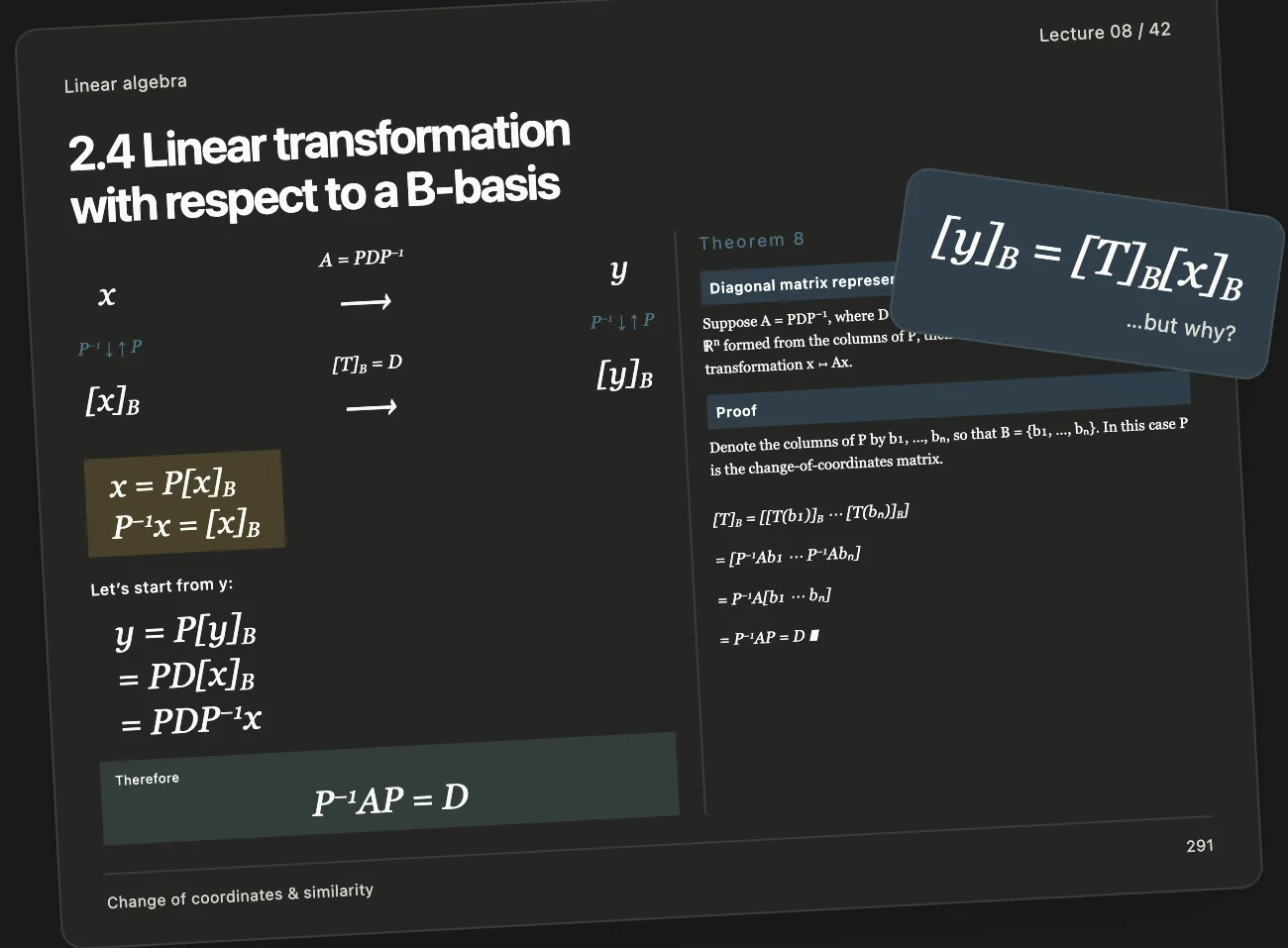
Converts v from the standard basis into B-basis coordinates.
D
2.
Scales the vector's components along the B-basis directions.
P
3.
Converts the resulting coordinates back into the standard basis.
1 / 3P⁻¹Start with v1 / 3P⁻¹Find both components2 / 3DDouble the blue component2 / 3DHalve the green component3 / 3PAdd the scaled components3 / 3PRead in standard coordinates
Standard basis
v = (2, 0)
v = b₁ − b₂
[v]B = (1, −1)
Blue coefficient
1 × 2 = 2
Green coefficient
−1 × ½ = −½
2b₁ − ½b₂
[Av]B = (2, −½)
Standard coordinates
Av = (2½, 1½)
Here b₁ ⟂ b₂. D = diag(2, ½)
Add in your topic slides, tutorials, labs
Create the topic
Confirm the plan
Simplify your lecture slides
Check your understanding
EdU/New topicDifferentiation
What will you learn today?
Drop in slides, tutorials and past year papers, or start with a question.

 EdU/Linear algebra